


नवग्रह शांति पूजा
Navagraha Shanti Puja by Video Call
Navagraha Shanti puja performed live for your family by video call: worship of the nine grahas with their mantras, grains and colours, from your home altar.
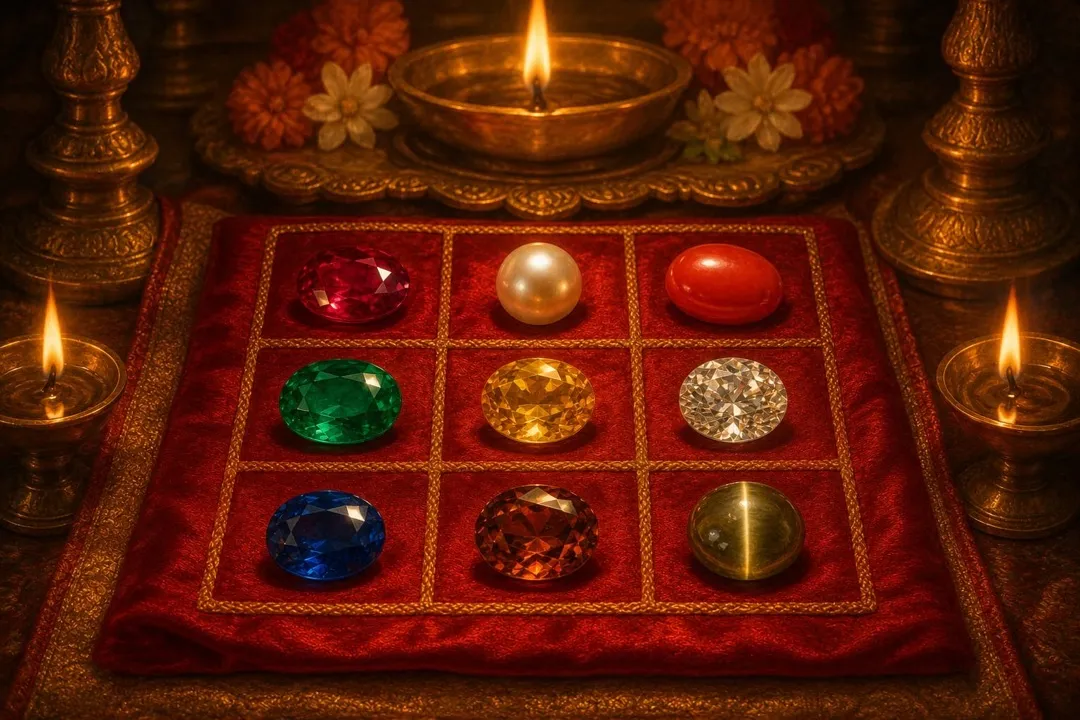
Traditionally done to bring the nine grahas into balance
Traditionally done before a wedding, a move or a new job
Traditionally done for steadiness during a difficult dasha
- 1–5pandits
- 2 hoursfrom, Basic
- LiveWhatsApp video or Google Meet
- 3 languagesSanskrit, Hindi, English
Choose your package
Four ways to hold this puja
The same puja at four scales. The pandit arranges all samagri at no extra charge; date, time and exact duration are confirmed on WhatsApp.
Basic
₹3,300 · US$40
- 1pandit
- Navagraha puja with each graha's beej mantra 108 times
- About 2 hours
- Puja of all nine grahas
- Beej mantra 108 times for each
Recommended
Advance
₹7,700 · US$90
- 2pandits
- Beej mantras 108 times each plus Navagraha havan
- About 3 hours
- Everything in Basic
- A second pandit
- Navagraha havan at the pandit's end
Premium
₹13,400 · US$160
- 3pandits
- Beej mantras 1,008 times each plus havan
- About 5 hours
- Everything in Advance
- Three pandits
- Graha-wise daan guidance
Super Premium
₹27,700 · US$330
- 5pandits
- Each graha's Vedic mantra 1,008 times plus havan with each graha's samidha
- 1–2 days
- Everything in Premium
- Five pandits
- Navagraha havan with the nine samidhas
Plan your puja
Good dates and your sankalp
Next good dates in New Delhi
Friday, 30 October 2026
India (IST): 06:31–09:04, Fri 30 Oct
Krishna Panchami · Mrigashira nakshatra
Sunday, 1 November 2026
India (IST): 06:32–14:52, Sun 1 Nov
Krishna Saptami · Pushya nakshatra
Tuesday, 10 November 2026
India (IST): 16:08–17:30, Tue 10 Nov
Shukla Dwitiya · Anuradha nakshatra
A general auspicious-day rule (good tithi and nakshatra, no Rahu Kaal), not a classical muhurta for this specific puja. The pandit confirms the final time on WhatsApp. Families abroad: we work out the window for your own city on WhatsApp.
Your sankalp
ॐ विष्णुर्विष्णुर्विष्णुः ।
अद्य शुभ दिने शुभ मुहूर्ते,
…… नामधेयाः वयं
सकल कुटुम्बस्य कल्याणार्थं
नवग्रह शांति पूजा करिष्यामहे ॥
A preview of the sankalp's form. On the day the pandit recites the full sankalp with the place, date, tithi and nakshatra. Nothing you type is saved on this website; it goes only into the WhatsApp message you send. A sankalp keepsake PDF after the puja is coming soon.
Book with this sankalpChant along
The mantra, in your script
ॐ ह्रां ह्रीं ह्रौं सः सूर्याय नमः
om hrām hrīm hraum sah sūryāya namah
Meaning: The seed syllables of Surya, with salutations to Surya.
The classical anushthan count is 7,000; daily, traditionally 108 times, beginning on a Sunday.
ॐ श्रां श्रीं श्रौं सः चन्द्रमसे नमः
om shrām shrīm shraum sah candramase namah
Meaning: The seed syllables of Chandra, with salutations to Chandra.
The classical anushthan count is 11,000; daily, traditionally 108 times, beginning on a Monday.
ॐ क्रां क्रीं क्रौं सः भौमाय नमः
om krām krīm kraum sah bhaumāya namah
Meaning: The seed syllables of Mangal, with salutations to Mangal.
The classical anushthan count is 10,000; daily, traditionally 108 times, beginning on a Tuesday.
ॐ ब्रां ब्रीं ब्रौं सः बुधाय नमः
om brām brīm braum sah budhāya namah
Meaning: The seed syllables of Budha, with salutations to Budha.
The classical anushthan count is 9,000; daily, traditionally 108 times, beginning on a Wednesday.
ॐ ग्रां ग्रीं ग्रौं सः गुरवे नमः
om grām grīm graum sah gurave namah
Meaning: The seed syllables of Guru, with salutations to Guru.
The classical anushthan count is 19,000; daily, traditionally 108 times, beginning on a Thursday.
ॐ द्रां द्रीं द्रौं सः शुक्राय नमः
om drām drīm draum sah shukrāya namah
Meaning: The seed syllables of Shukra, with salutations to Shukra.
The classical anushthan count is 16,000; daily, traditionally 108 times, beginning on a Friday.
ॐ प्रां प्रीं प्रौं सः शनैश्चराय नमः
om prām prīm praum sah shanaishcarāya namah
Meaning: The seed syllables of Shani, with salutations to Shani.
The classical anushthan count is 23,000; daily, traditionally 108 times, beginning on a Saturday.
ॐ भ्रां भ्रीं भ्रौं सः राहवे नमः
om bhrām bhrīm bhraum sah rāhave namah
Meaning: The seed syllables of Rahu, with salutations to Rahu.
The classical anushthan count is 18,000; daily, traditionally 108 times, beginning on a Saturday.
ॐ स्रां स्रीं स्रौं सः केतवे नमः
om srām srīm sraum sah ketave namah
Meaning: The seed syllables of Ketu, with salutations to Ketu.
The classical anushthan count is 17,000; daily, traditionally 108 times, beginning on a Tuesday or Saturday.
Download the free Chant-along PDFLetter-by-letter transliteration of the Sanskrit, not a translation. No login.
Samagri
What goes into this puja
All samagri is arranged by the pandit — no extra charge.
Puja essentials9
- Navagraha yantra or picture
- Nine small heaps of grain on the chowki: wheat, rice, masoor, moong, chana dal, white rice, black sesame, urad, mixed grain
- Coloured cloths or flowers for the nine grahas
- Ghee lamp (diya) with cotton wicks
- Incense sticks and camphor
- Roli (kumkum), haldi, chandan and akshat (unbroken rice)
- Bell and aarti plate
- Puja books and the sankalp with the family's names and gotra
- Mala for counting
Havan items (from the Advance package)5
- Havan kund, about 1 × 1 ft copper or 1½ × 1½ ft brick
- Samidha: navgraha samidha: aak (Surya), palash (Chandra), khair (Mangal), apamarg (Budha), peepal (Guru), gular (Shukra), shami (Shani), durva (Rahu), kusha (Ketu)
- Cow's ghee for the ahutis (about 1 kg per 1,000 ahutis)
- Havan samagri mix: sesame, barley, rice, guggul, sugar and dried herbs
- Sruva (ladle), kusha grass and a dry coconut (gola) for the purnahuti
Kalash and altar4
- Copper, brass or steel kalash filled with water
- Five mango or betel leaves
- Coconut wrapped in red cloth with mauli
- Low chowki with a clean red or yellow cloth
Offerings and naivedya2
- Nine fruits or sweets
- Daan items as the pandit lists for each graha
Across the miles
A puja for a loved one far away
Living abroad and want a puja for your parents in India, or the other way round? Book it for them: the pandit performs it with their names in the sankalp, and we send ONE shared Google Meet link so the whole family joins from wherever they are, in one call.
How it works
- Tell us who the puja is for, their city, and where the rest of the family will join from.
- We fix a time that suits every time zone and send one Google Meet link to share with the family.
- Everyone joins the same call; the pandit names the whole family in the sankalp.
Book for a loved one
Pujas for your Kundli
Which puja suits your chart?
Free quick check
See which doshas your chart shows and the pujas traditionally done for them. No chart, no reading, nothing saved.
Full Kundli + personalised puja plan
Your complete Kundli, with the pujas recommended for your own chart, ranked, in the Janma Granth PDF. Kundli generation is a paid product; the free check above is not a reading.
Get your full KundliCertificate included
A keepsake after the puja
After the puja we send your family a black-and-gold certificate with your names, the puja, the date and the pandit's name, on WhatsApp.
ॐ
ProperPandit · Keepsake
Certificate of Puja
The Sharma Family
took part in the Navagraha Shanti Puja · नवग्रह शांति पूजा
1 November 2026
Date of the pujaPandit (name on your certificate)
Performed by
Open the sample certificate (PDF) · placeholder names.
Book a Navagraha Shanti puja (नवग्रह शांति) performed live for your family on a one-on-one video call. An experienced pandit we work with recites the sankalp with your names and gotra and leads the worship of the nine grahas, each with its own mantra, grain and colour, while your family makes the offerings at your home altar, anywhere in the world.
01What the Navagraha Shanti Puja is, and when families hold it
The navagraha are the nine grahas of Vedic astrology: Surya (Sun), Chandra (Moon), Mangal (Mars), Budha (Mercury), Guru (Jupiter), Shukra (Venus), Shani (Saturn), and the lunar nodes Rahu and Ketu. A Navagraha Shanti puja worships all nine together, asking for their influences to be peaceful (shanti) and favourable.
Families hold it at the start of a new phase of life: before a wedding, after a Griha Pravesh, at the start of a new dasha (planetary period), during Sade Sati, or when a kundli reading suggests that several grahas are weak or afflicted. It is also commonly included within larger rites such as a wedding or a house-warming.
02What the Navagraha Shanti Puja is traditionally done for
- Traditionally done to bring the nine grahas into balance.
- Traditionally done before a wedding, a move or a new job.
- Traditionally done for steadiness during a difficult dasha.
When: at the start of a new planetary period (dasha), before major life events, or when the kundli suggests it.
03Count, duration, and what is included
Each graha's beej mantra 108 times (Basic and Advance) or 1,008 times (Premium and Super Premium). Typical durations are listed in each package below; the price, the date, the time and how long the puja takes are confirmed with you on WhatsApp when you book.
Included in every package:
- Either a live call or a video recording of the puja if you cannot attend, never both
- All samagri, arranged by the pandit at no extra charge
- Sankalp in your family's names and gotra
- Date and muhurat worked out for your city
- Keepsake certificate after the puja (Certificate included)
Not included:
- Shipping of prasad
- Any in-person visit by a pandit
04How the Navagraha Shanti Puja works by video call
The Navagraha Shanti Puja is performed live by an experienced pandit we work with, on a one-on-one video call with your family. You stay at home, anywhere in the world, and do the offerings with your own hands while the pandit leads. The steps:
- Book on WhatsApp: Message us on WhatsApp with the puja you want, your city and country, and your time zone. The button on this page fills in the puja and your time zone for you; you add your city.
- Choose the date and muhurat: We suggest dates and times in your own local time. Where the puja calls for a muhurat (an auspicious window), it is worked out from the panchang for the city you are in, not for India.
- Samagri arranged for you: The pandit arranges all the samagri for the puja, at no extra charge; you only need a clean, quiet place at home to sit for the call.
- Join the video call: At the agreed time you join a one-on-one video call with the pandit from your home altar, on WhatsApp video or Google Meet, whichever your family prefers. It is your family's call alone.
- Sankalp with your names and gotra: The pandit begins with the sankalp: the formal statement of the place, the date, the names of the family members, your gotra and the intention of the puja.
- The puja: The pandit recites the mantras and guides each offering step by step, so that the hands placing the flowers, the water and the lamp are your own.
- Aarti: The puja closes with aarti: you wave the lamp at your altar while the pandit sings, and the whole family can join in.
- Prasad guidance: The pandit tells you how to offer and share the prasad, and what to do afterwards with the flowers, the kalash water and the other offerings.
On the call the pandit leads the Ganesh puja and the kalash, then sets up the nine grahas with you: nine small heaps of grain arranged in the traditional pattern, with Surya in the centre. The pandit recites each graha's mantra and guides the offering to each in turn; where you can hold a small havan safely, the closing ahutis are offered into the fire.
05Who it suits
It suits families at a turning point, those advised by an astrologer to strengthen several grahas at once, and families who want a single, complete puja for the planets rather than separate remedies. You can look at your own chart for free with our Free Kundli before you book.
06Timing and muhurat
Sundays and Saturdays are common choices, and many families prefer a day with a favourable nakshatra and tithi. For a puja tied to a particular graha's period, the pandit may suggest that graha's weekday. We compute the muhurat for your city; the Muhurta Finder lists dates by occasion.
07Booking, payment and rescheduling
All bookings are made on WhatsApp. You pay on WhatsApp by UPI (in India), PayPal, USDT or card-to-USDT; nothing is paid on this website. Payments are not refundable, but you can reschedule up to two times if you tell us at least 48 hours before the puja (see our refund policy).
The call is on WhatsApp video or Google Meet, whichever your family prefers. The pandit performs the puja in Sanskrit and speaks Hindi; a team member who speaks English joins the live call to help families who prefer English.
If your family cannot attend live, the pandit performs the puja for you and we send you a video of it instead. It is either a live call or a video recording, never both: a live call is not recorded. The price, the date, the time and how long the puja takes are confirmed with you on WhatsApp when you book.
Frequently asked questions
- Can Navagraha Shanti puja be done online?
- Yes. The family sets up the nine grains and the kalash at home, and the pandit recites each graha's mantra and guides each offering by video call.
- Do we need our kundli for this puja?
- Not to hold it. If the puja is for a particular person's chart, share their birth details on WhatsApp so the pandit can include them in the sankalp.
- Do we need to do a havan?
- A havan is traditional, but it can be done in a small, safe form or left to the pandit's recitation where a fire is not possible in your home.
- How do I book the Navagraha Shanti Puja by video call, and how do I pay?
- Tap "Book on WhatsApp" and send the message with your city and time zone. We agree the date, the time and the details with you there. You pay on WhatsApp by UPI (in India), PayPal, USDT or card-to-USDT; nothing is paid on this website.
- What if we need to change the date?
- You can reschedule up to two times if you tell us at least 48 hours before the puja. Payments are not refundable; the refund policy page has the full terms.