


गृह प्रवेश
Griha Pravesh Puja: Meaning, Types, Steps and How to Prepare
Puja guide · 8 sections · 7 questions answered
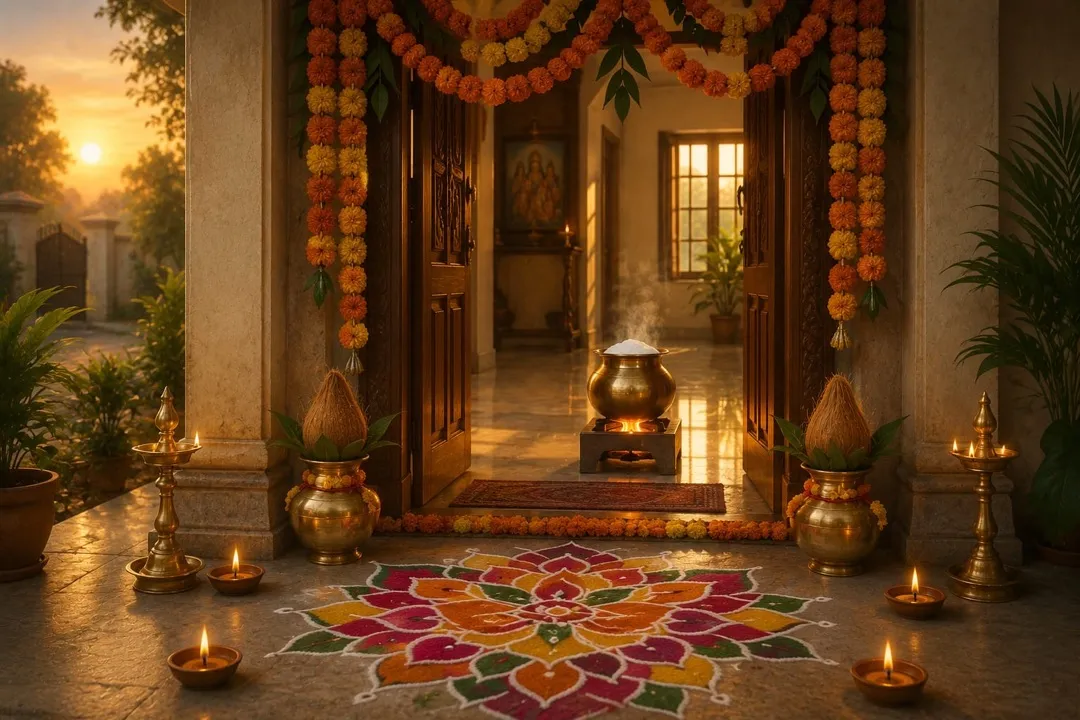
Griha Pravesh (गृह प्रवेश) means "entering the house" and is often called a housewarming puja in English: the puja a Hindu family holds on first moving into a new home (in the traditional scheme, a newly built one) and, in traditional accounts, on returning after living away or re-entering after rebuilding. The rites vary by region and family but commonly include Ganesh puja, a kalash, Vastu puja, a havan and boiling milk in the new kitchen. A pandit traditionally chooses the muhurat (date and time) from the panchang; this guide gives no dates.
01What Griha Pravesh means
Griha (गृह) means house and pravesh (प्रवेश) means entering; Sanskrit dictionaries give it as a solemn entry into a house according to prescribed rites. The word also names a wedding rite, the bride's first entry into her husband's home (also known as Vadhu Pravesha). This guide covers the house ceremony.
In English it is often called a housewarming. Traditionally the rites end with a meal for guests and dakshina (the customary gift or fee) for the pandit. Regional names include Griho Probesh (Bengali), Graha Pravesam (Tamil), Gruha Pravesam (Telugu, Malayalam) and Gruha Pravesha (Kannada).
02The three types of Griha Pravesh
Traditional accounts describe three types. The names are broadly similar (one encyclopaedia writes sapurva as 'sampurva'), but sources define the second and third differently.
| Type | When it applies | Example |
|---|---|---|
| Apurva (अपूर्व), "quite new" | First entry into a newly built home | A house you have just built, or a newly built flat |
| Sapurva (also sapoorva or sampurva) | Entering an existing home again after living elsewhere or abroad | Coming home from abroad or from another city |
| Dwandwah (also dvandva) | Re-entering after the house has been rebuilt or renovated | Moving back after repairs following a fire or flood |
Some modern guides also use sapurva for a resale, rented or previously lived-in home. Ask your pandit which type fits your move.
03What usually happens on the day
The order and content vary by region and family, though Ganesh puja usually comes first, and your pandit may add, shorten or reorder rites. Common elements:
- Ganesh puja: Ganesha, the god of beginnings, revered as the remover of obstacles, is honoured at the start of rites.
- Kalash sthapana (installing the kalash): a pot, commonly of water topped with mango leaves and a coconut, is worshipped; as on other important occasions, a kalash may stand near the entrance as a sign of welcome.
- Entering the home: in some families the woman of the house or the family head enters first with a decorated coconut, which is then broken or placed at the doorway; in some places a cow is led in first.
- Vastu puja or Vastu Shanti: rites for the deities of the site, often with a havan. One reference places it outside, before the family enters.
- Navagraha puja, which some families add: worship of the nine grahas (the Sun, Moon, five planets, Rahu and Ketu).
- Havan: offerings such as ghee and grains made into a ritual fire.
- Boiling milk on the new kitchen stove until it rises over the rim, traditionally seen as a sign of abundance.
- Satyanarayan puja: some families, by custom or on the pandit's advice, add a Satyanarayan puja and katha to the occasion.
- Aarti (waving of lamps), prasad (blessed food) and the meal for guests.
04How to prepare: a practical checklist
Practical steps, not ritual rules; where your pandit says otherwise, follow the pandit.
- Ask for the samagri (puja materials) list and who brings what. Accounts name basics such as a kalash, mango leaves, a coconut, flowers, fruit, milk, and ghee and grains for a havan; some temples supply the kalash.
- Clean the home, finish repairs if you can, and clear a space for the puja with seating for the family and the pandit.
- Hang a toran of mango or ashoka leaves and flowers over the main door, and draw a rangoli at the entrance, as for other auspicious occasions.
- Ready the kitchen: a working stove, milk and a vessel for boiling it (some families use a new one).
- In a flat, ask how large the havan fire will be, keep windows open, follow your society's rules on indoor fires, and never cover or switch off smoke alarms.
05Choosing the date and time
Traditionally a pandit or astrologer chooses the muhurat (auspicious window) from the panchang, the Hindu almanac. For Griha Pravesh the factors checked include the tithi (lunar day), nakshatra (lunar mansion), weekday and lunar month, and timings depend on where the home is.
Some periods are left out altogether. One panchang publisher, citing the Muhurta Chintamani and the Dharmasindhu, removes days when Jupiter (Guru) or Venus (Shukra) is set (asta: too close to the Sun to be seen, which can last weeks) and the extra (adhik) lunar month. Regions and families also differ on which months and weekdays they avoid.
06Where Bhoomi Puja and Vastu Shanti fit
Bhoomi Puja comes before building, and Vastu Shanti is often held within Griha Pravesh; see which rite fits each stage.
07Before you call your pandit
Questions to settle on the first call, ideally before you book movers or invite guests:
- Which type of Griha Pravesh applies to your move.
- Which muhurat window suits your city and the dates you can manage.
- Which rites they plan, and how long these will take.
- What is on the samagri list, and what they will bring.
No regular pandit? Ask relatives or a local temple; some temples list priest services for home ceremonies such as Griha Pravesh.
08Where to go next on ProperPandit
This free guide explains the rite in general terms; it gives no muhurat dates, full samagri lists or mantra texts, and does not replace your family pandit.
- Puja for home & property names the rite for each stage of a home, from building to moving in, and lists the related pujas in ProperPandit's catalogue.
- The Satyanarayan Puja guide explains the puja and katha that some families add.
- The Muhurta Finder lists auspicious dates by occasion for your city, to discuss with your pandit.
- Divine booking is where you ask ProperPandit to arrange a pandit for a puja.
Frequently asked questions
- Is Griha Pravesh the same as a housewarming puja?
- Griha Pravesh is the traditional Hindu ceremony of entering a new house. In English it is often called a housewarming puja. Unlike a housewarming party, its core is the rites themselves (commonly Ganesh puja, kalash, Vastu puja and often a havan), usually held at a muhurat a pandit chooses; a meal for guests traditionally follows.
- Is Griha Pravesh necessary?
- In many Hindu families it is considered the proper way to begin living in a new home, and traditionally the rites came before moving in. How much is done varies, from a short Ganesh and kalash puja to full rites with a havan; your family decides with your elders and pandit.
- Can Griha Pravesh be done without a muhurat?
- Traditions differ, and this guide cannot rule for your family. Traditionally a pandit chooses the date and time, and many families wait for the rites before moving in. If the move cannot wait, tell your pandit your moving date and ask what your tradition allows.
- Can Griha Pravesh be done in the evening?
- Traditions differ, and this guide cannot rule for your family. At least one panchang publisher works out Griha Pravesh muhurat windows from one sunrise to the next, and its published listing includes windows that begin in the evening or at night. Whether an evening entry suits your family is for your pandit and your family's custom; some families prefer the morning.
- Which day or tithi is best for Griha Pravesh?
- No single day or tithi suits every family. The pandit reads the tithi with the nakshatra, weekday and lunar month for your city, so a tithi that suits one date may not suit another.
- Do families hold Griha Pravesh in a rented home?
- Some families do, and some puja services describe a Griha Pravesh for a rented home, held on moving day or at a muhurat the pandit suggests. How much of the rite to hold is your family's decision. Before an indoor havan, check your lease and the housing society's rules on open flames.
- We have already moved in. Can we still hold Griha Pravesh?
- Traditionally the rites came before moving in, and some guides still say so. Tell your pandit you have already moved in and ask how your tradition handles it.