


सत्यनारायण पूजा
Satyanarayan Puja (Katha): When, How and What to Prepare
Puja guide · 8 sections · 5 questions answered
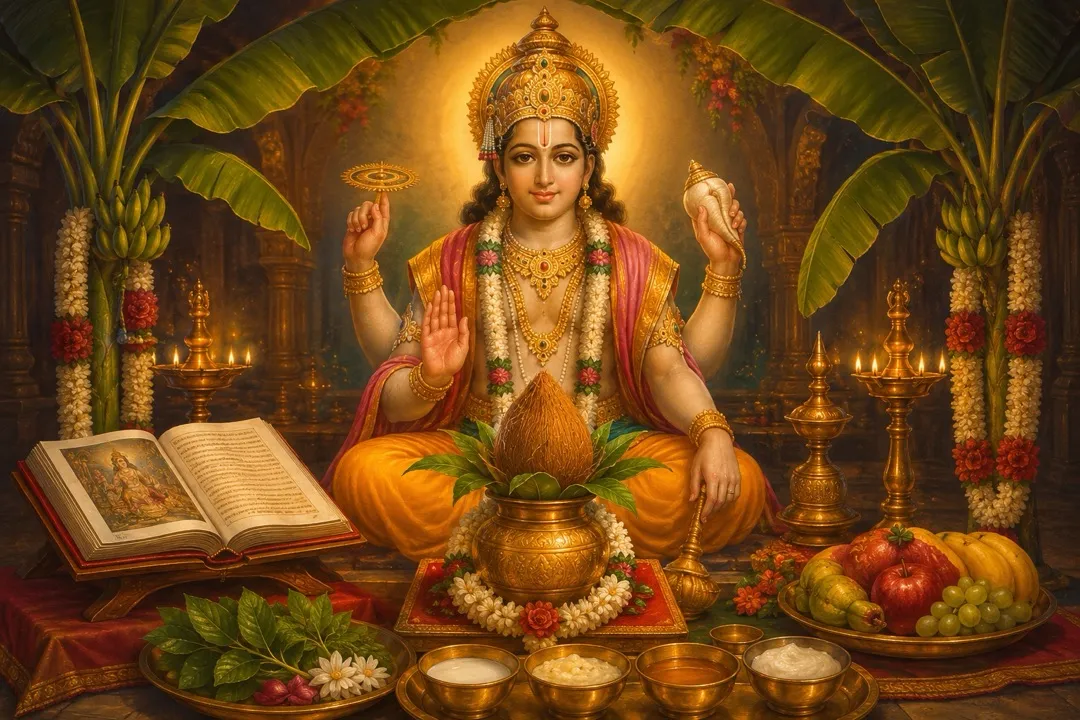
Satyanarayan Puja (सत्यनारायण पूजा) is worship of Vishnu as Satyanarayana. At its heart is the vrat katha, a short story, usually in five chapters, read aloud and followed by aarti and shared prasad. The katha sets no fixed day; many families choose Purnima, the full-moon tithi (lunar day), or a family occasion. Many families hold it at home; whether a pandit leads it or a family member reads the katha is a matter of family custom. Where your family's practice differs from this guide, follow your family.
01When families hold it
The katha ties the puja to no single date. In the Sanskrit text, Vishnu tells Narada it may be done on any day, at nightfall, with devotion, together with Brahmins and relatives. Later in the story the merchant keeps it on the full-moon day and at Sankranti. Purnima is a common choice today, and some temples hold the puja every Purnima.
Families also hold it for an occasion, such as moving into a new home, a wedding, a new job or an anniversary, or to keep a vow.
02Samagri: what families usually prepare
A typical, modest list. Lists differ by region, and your pandit or elders may add or drop items.
- Altar: a picture or idol of Satyanarayan (some families use a shaligram), a small Ganesh idol or picture, a low seat (chowki) with a clean cloth, flowers and garlands, and a printed copy of the katha.
- Kalash: a copper, brass or silver pot of water, mango leaves, and a coconut wrapped in cloth.
- Worship: haldi, kumkum, chandan (sandalwood paste), akshat (rice), incense, a ghee or oil lamp, camphor, a bell, betel leaves and supari, fruit, tulsi leaves, and coins or money for dakshina.
- Panchamrit: milk, curd, honey, ghee and sugar.
- Prasad: banana, ghee, milk, sugar or jaggery, and wheat flour or rava (semolina).
03The usual steps at home
The katha is a story, not a manual. The order of worship comes from the vidhi your family or pandit follows, and vidhis differ; some, for example, set up the kalash before the Ganesh puja. A common order:
- Prepare: clean the space, bathe, and set up the altar, kalash and offerings.
- Sankalp: the person holding the puja states the place and time, their name (often with their gotra), the occasion and their intention; many hold water, rice and a flower while doing so.
- Ganesh puja, as at the start of most Hindu rites.
- Kalash: set up and worship the kalash.
- Satyanarayan puja: worship with the offerings your vidhi lists. The short form (panchopachara) has five: sandalwood paste, flowers, incense, a lamp and food (naivedya). The fuller sixteen-step form (shodashopachara) also includes bathing the deity with water and panchamrit. Tulsi leaves, used in Vaishnava worship, are commonly offered as well.
- Katha: read or listen to all five chapters together.
- Dakshina: the Sanskrit katha speaks of giving dakshina (a gift or fee) to a Brahmin after the katha; ask your elders about your family's custom.
- Aarti and prasad: offer the prasad and share it with everyone present. Some families also sing bhajans.
04Holding it yourselves: who leads and what to read
In the katha the vrat is open to anyone with devotion: a poor Brahmin, a woodcutter, a merchant's wife with her relatives and a group of cowherds with their families all keep it. The scholar H. R. Divekar found no restriction of caste or gender on who may keep it.
The same text speaks of worshipping with Brahmins and relatives and of giving dakshina to a Brahmin, so families differ. Some have one family member lead and read the katha from a printed copy in a language everyone follows; others invite a pandit or a learned elder to recite it with the Sanskrit mantras. If you have no printed copy, the Sanskrit text and an English rendering are published free on sanskritdocuments.org.
05Prasad: what families make and share
The katha names the offering: banana, ghee, milk and wheat flour, or rice flour if there is no wheat, with sugar or jaggery, each sapāda and mixed together. Sapāda is Sanskrit for "increased by a quarter", usually read as one and a quarter measures; the Concise Encyclopedia of Hinduism gives 1.25 kg as an example. An English rendering of the katha asks for equal amounts of each ingredient, in that measure or multiples of it. Make enough for everyone present.
Recipes differ by region and family. Many families cook rava (semolina) with ghee, milk, sugar and banana, a sweet called sheera or sapaad. In many North Indian homes the prasad is panjiri, wheat flour roasted in ghee, given out with panchamrit. Panchamrit and tulsi leaves are commonly offered too.
06The katha in five chapters
Versions differ; the Bhavishya Purana version, for example, names the merchant Lakshapati. This outline follows the Sanskrit text attributed to the Reva Khanda. What happens to the characters good or bad, is part of the story, not a promise or a warning about what the puja will do.
- Chapter 1: Narada sees people suffering and asks Vishnu for an easy way to relieve it. Vishnu describes the vrat.
- Chapter 2: A poor Brahmin in Kashi learns of the vrat from Vishnu, disguised as an old Brahmin, and keeps it; so does a woodcutter, and in the story both their lives change.
- Chapter 3: A merchant vows to hold the puja if he has a child, then keeps putting it off after his daughter Kalavati is born. He and his son-in-law are jailed when a thief drops royal wealth beside them, until his wife Lilavati keeps the vrat.
- Chapter 4: Sailing home, the merchant tells a disguised ascetic that his boat holds nothing but creepers and leaves, and the cargo turns to leaves until he repents. Kalavati, hurrying to meet her husband, leaves without taking the prasad; his boat sinks from sight until she goes back and takes it.
- Chapter 5: King Tungadhvaja (Angadhvaja in one English rendering) scorns prasad offered by cowherds and loses his wealth and his hundred sons, until he worships with them.
Two threads run through the story: keeping a promise, and receiving prasad with respect, whoever offers it. In chapters 4 and 5, the turning point is a character who left or scorned the prasad turning back: Kalavati goes home and takes it, and the king joins the cowherds' worship.
07Where the katha comes from
The puja is also called Satyanarayan Katha, and in Andhra Pradesh, Satyanarayana Vratam; the Annavaram temple there has a hall where devotees perform it.
Printed versions usually place the katha in the Reva Khanda of the Skanda Purana, and a related version appears in the Bhavishya Purana. Scholars disagree about its age. It is reported in the Bengali Vangavasi edition of the Skanda Purana but not in others, such as the Venkateshvara Press edition; the scholar H. R. Divekar could not find it in any printed edition he checked, and one manuscript attributes it to a different text. Several scholars see it as a later addition; Sarat Chandra Mitra argued instead that its place in the Reva Khanda shows the worship is older.
08What ProperPandit offers
This guide is free to read. It sets out common practice from the sources above and leaves family decisions, such as the day, the version of the katha and any havan, with you, your elders and your pandit.
If the puja is part of moving into a new home, our Griha Pravesh puja guide explains the house-entry ceremony itself. Find My Puja lists pujas from ProperPandit's catalogue by concern; the lists are editorial and the same for everyone, not a reading of your chart.
Frequently asked questions
- Does Satyanarayan Puja have to be on Purnima, or in the evening?
- Purnima is not required: the katha allows any day, and Purnima is a common choice; the Concise Encyclopedia of Hinduism also names Sankranti and Ekadashi. On the time, the Sanskrit text says to worship at nightfall, and many families hold it in the evening; some hold it in the morning. For a specific muhurat, ask your family pandit. Families who avoid grains on Ekadashi should ask their pandit how they make the prasad on that day.
- Can we do Satyanarayan Puja at home without a pandit?
- Yes, families can hold it at home: the Concise Encyclopedia of Hinduism lists one's own house among the places for it, and in the katha householders keep the vrat themselves. Because the Sanskrit text also speaks of worshipping with Brahmins and giving dakshina to a Brahmin, some families invite a pandit or a Brahmin guest, while others have a family member lead. Follow your family's custom.
- Do we have to fast on the day?
- The katha does not ask for a fast, and the scholar H. R. Divekar found no fasting rule attached to the rite. Many families still fast until the puja and break the fast with the prasad. Follow your family's custom; anyone unwell or pregnant should check with a doctor before fasting.
- How long does Satyanarayan Puja take?
- It depends on the reading, how elaborate the worship is and whether a havan is added. One temple listing, for example, allows one and a half hours, or two hours with a havan. A family reading at home may take more or less time.
- Can we read the katha in Hindi or another language?
- The katha does not say which language it must be read in; it speaks of hearing the story together. Printed and recorded versions exist in other languages, including Hindi and English, and the Sanskrit puja text is also published in other scripts, such as Tamil. If your family has always used the Sanskrit text, ask your elders or pandit.